
WORTH YOUR TIME - NINE
With guest writer Ross Taylor



Ross Taylor is Achievement Man - he talks and does. That’s rare. He’s the guy who earlier this century started and became the first President of Perth’s Indonesia Institute - now the go-to place for hard opinion.
A former WA Government Commissioner to Indonesia he’s also been National Vice-President & WA State Chair of the Australia-Indonesia Business Council, with Wesfarmers Ltd and Phosphate Resources Limited. He also operated his own business in Medan, Sumatra for three years.
Ross is involved in philanthropy and cancer-charity work throughout the region and is one of Australia’s leading commentators on Indonesia-Australia relations writing ‘Opinion’ articles for The Australian, The West Australian and The Jakarta Post newspapers & The Diplomat based in Washington DC, and also for the Lowy Institute on a regular basis. & commentates on SkyNews, and ABC Radio programs.
Ross is also the author of three published books. In 2013 Ross was appointed by the Governor-General of Australia as a Member of the Order of Australia (AM) for significant services to Australia-Indonesia relations and to the (philanthropic) community. Ross was also selected, in July 2013, by the Indonesian Government as Australia’s “Presidential Friend of Indonesia – 2013.”
Here’s his latest take on Indonesian-Australian relations, somewhat different from the mainstream media’s glowing commentaries. It was first published by Linkedin.
MAYBE SOME BUMPS AHEAD WITH ALBO’S NEW BEST MATE
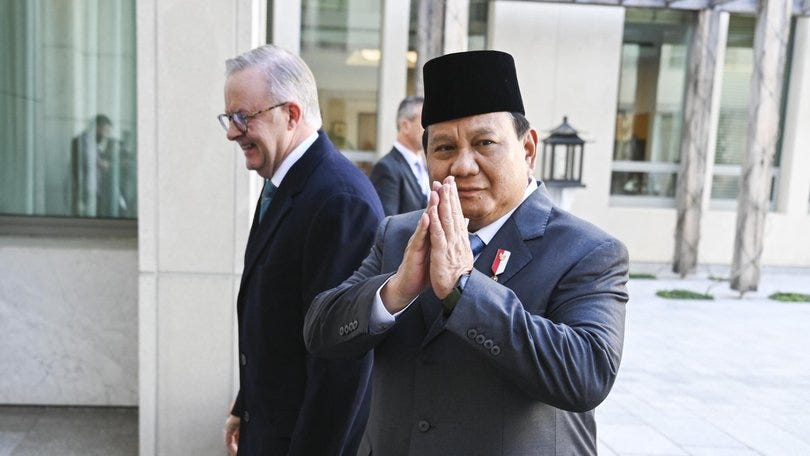
“Australia and Indonesia share deep trust and an unbreakable bond as neighbours, partners and friends.” These words earlier this week from Prime Minister Anthony Albanese in Jakarta confirmed that the Australia-Indonesia relationship is now very strong following the signing of a security treaty.
But the warm relationship currently enjoyed by both countries, belies the probability of deeper challenges for the bilateral relationship further down the track.
After just 16 months into his presidency, rather than nurturing Indonesia’s democratic institutions, Prabowo’s early tenure shows troubling signs with the consolidation of power - a backslide that matters not just for Indonesia, but for the entire Indo Pacific region.
Prabowo is no political novice, and his first year in office suggests he is more interested with locking in control than strengthening democratic checks and balances saying that, “democracy is very tiring.”
Prabowo has already expanded his Cabinet into a sprawling collection of ministries and coordinating bodies so large that even Indonesian analysts joke that it requires its own map.
But the expansion is not merely a bureaucratic indulgence. He has used ministerial appointments to draw in nearly every major political bloc. Leaders or influential figures from seven of Indonesia’s eight major parties now hold senior government posts. In effect, Prabowo has co-opted almost the entire Indonesian political class. This is coalition-building in the most transactional sense: reward your rivals until no meaningful opposition remains.
Prabowo’s ties to the past are also hard to ignore. His Suharto-era military pedigree raises inevitable questions about how comfortable he is with descent. His approach to governance - centralised, heavily personalised, and reliant on patronage - resembles something closer to managed autocracy than open democracy. Expanding the nation’s military, the largest increase in decades, does little to placate worried observers about Indonesia’s strategic direction.
Prabowo’s foreign policy only adds to the confusion. His adopted guiding mantra - a thousand friends, zero enemies - sounds broad-minded but in practice has produced inconsistency bordering on incoherence.
He has courted both China and Russia, along with a deeper involvement in international affairs including membership of BRICS, whilst simultaneously embracing Australia with this new security treaty along with a calculated warm and charm offensive with Prime Minister Albanese.
Australia needs this close strategic alliance with Indonesia to balance the expansionary policies of China and the chaos of the Trump administration. But as Indonesia’s democratic backsliding gathers pace, will Australia be prepared to turn a blind-eye to an increasingly autocratic-led neighbour who seeks to crush dissent and freedom of speech amongst his 280 million citizens?
##